
5 quick ideas about why and how to resist
The rich already run everything, and they’re grabbing more power. Build your power with others and find new ways to resist. We have ways to make things, communicate, and live that don’t depend on corporations. Maybe we forgot. But we can do things on our own.

Anti-trans feminism since the 1960s
After a couple of recent essays by Sophie Lewis chronicling this movement. Particularly because the anti-trans movement is fond of suggesting that trans people sprang into existence yesterday, I’m fascinated with timelines.
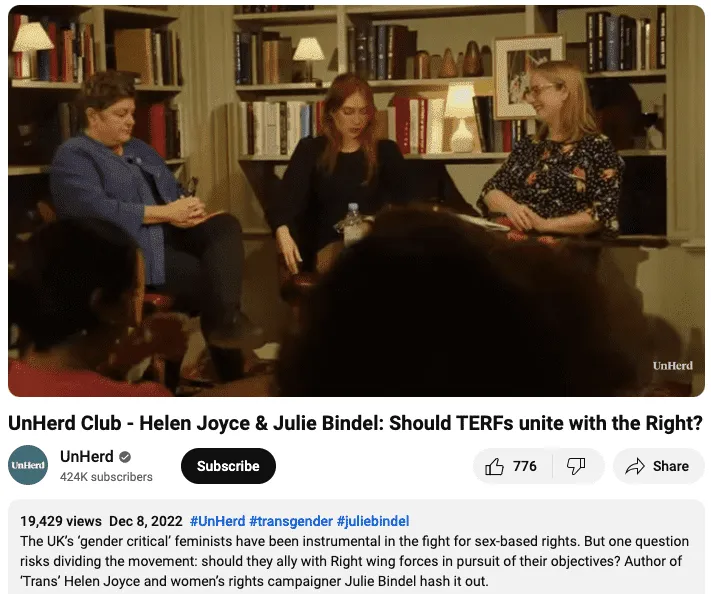
Would you work with the ‘Alliance Defending Freedom’?
A 2022 Bindel–Joyce debate in which Joyce calls my gender ‘an attack on the whole institution of civilization’. She thinks she’s preserving ‘the Enlightenment,’ ‘evidence,’ ‘stable meanings,’ ‘how you do science’, ‘the whole institution of civilization.’

Trans volta
I didn’t choose the word ‘trans’ to describe my unique life path, nor would I have chosen it, but these days, this word happens to be the umbrella that works in the rain. A word you can use alongside ‘trans’ is ‘volta’.
Assume humanity, then ask about happiness
Trans people‘s say-so is evidence of our happiness. But no one should ask for evidence that trans people are people. Previously, I used Lydia Polgreen’s opinion as an example, and I identified and extracted these writing tips for you. Please note this key distinction.

No one needs ‘evidence’ that transition improves trans people’s humanity
Let’s distinguish scientific uncertainty from value judgment. Anti-trans prejudice doesn’t justify demanding evidence about trans people’s humanity. When we let go of prejudice, some common ‘questions’ dissolve.

Can an identity be true and not true?
On ‘constitutive tension’ in our concepts. Picking apart someone else’s identity? First ask: Why do you want to? What would be gained? And lost? What happens to your own identity in the process?

Gödel is sure Bach, and trans people are sure their gender
Reflections on the Pulitzer-winning ‘Gödel, Escher, Bach’ (1979). Their objection is an infinite regress. They’re laying a trap. If we needed rules about rules about rules, none of us could ever use language at all.

How do we know who we are?
Do we learn it from a crystal ball—or from our guts? How do others state with certainty that they know who they are? Do they have a crystal ball? Of course, we’re jealous. How can we know ourselves, too?